
Uncategorized
Importance of Physical Activity in Pre-Primary Education

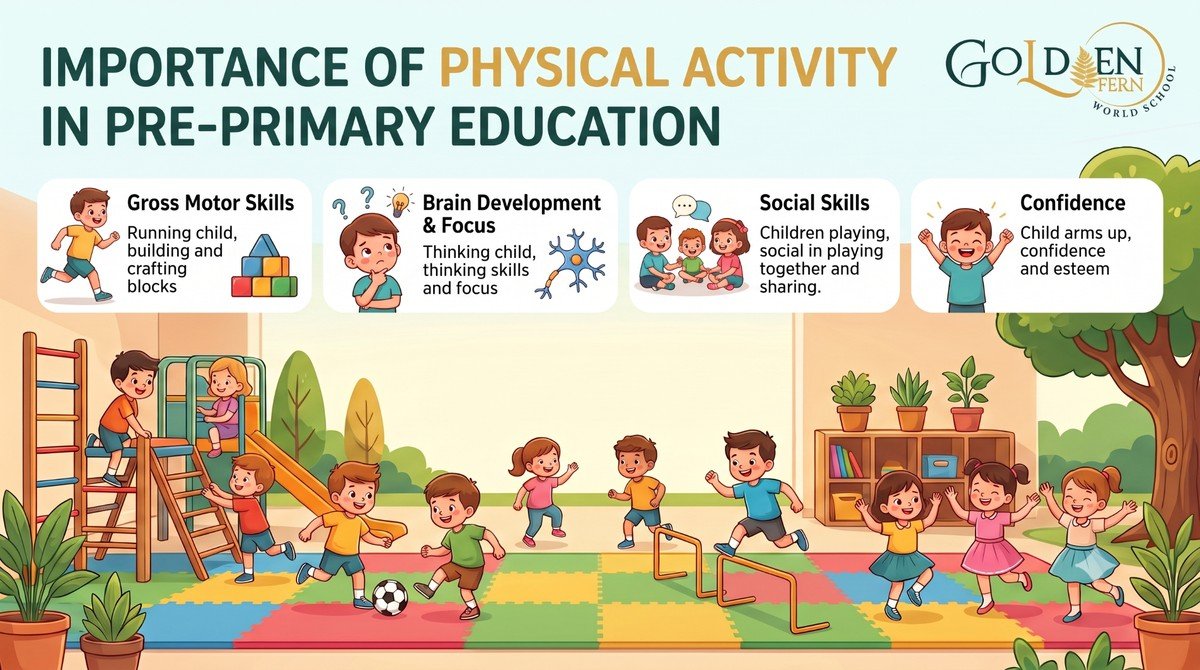
Young children are full of energy. They want to move, explore, touch, run, jump, and discover things around them. A pre-primary classroom should give children enough opportunities to use this natural energy in meaningful ways.
Physical activity is not simply about playing outdoors. For young children, movement can become part of their everyday learning experience. A jumping game can introduce numbers, a movement song can improve listening, and a simple ball activity can teach children how to cooperate with friends.
This is why physical activity has an important place in pre-primary education. It supports children’s body development while also creating opportunities to improve confidence, communication, concentration, and social behaviour.
At Golden Fern World School, we believe that early learning should include opportunities for children to move, participate, explore, and enjoy their school experience.
What Does Physical Activity Mean for Young Children?
Physical activity for young children does not mean intensive exercise or formal training. It can be any safe movement that is suitable for their age and development.
Children can stay active through simple experiences such as:
- Walking and running
- Jumping and hopping
- Dancing to children’s songs
- Playing with soft balls
- Balancing activities
- Action songs
- Simple obstacle games
- Outdoor exploration
- Stretching and movement games
The purpose is to make movement enjoyable while allowing children to practise different physical abilities.
1. Helps Children Become Comfortable With Movement
During the early years, children are learning how their bodies work. They are discovering how to move faster, slow down, maintain balance, reach for objects, and change direction.
Regular movement activities give them repeated opportunities to practise these abilities.
For example, a simple game that involves walking, stopping, and changing direction can help a child become more aware of body movement and space.
2. Strengthens Gross Motor Development
Gross motor skills involve larger body movements. Young children use these skills every day when they walk, climb, run, jump, or play.
Pre-primary activities can provide natural practice for these movements.
A teacher may organise a small activity where children jump over soft markers, walk between lines, or roll a ball towards a target. Such experiences can help children practise movement while enjoying the activity.
3. Improves Hand and Eye Coordination
Children also need to learn how their eyes and hands work together.
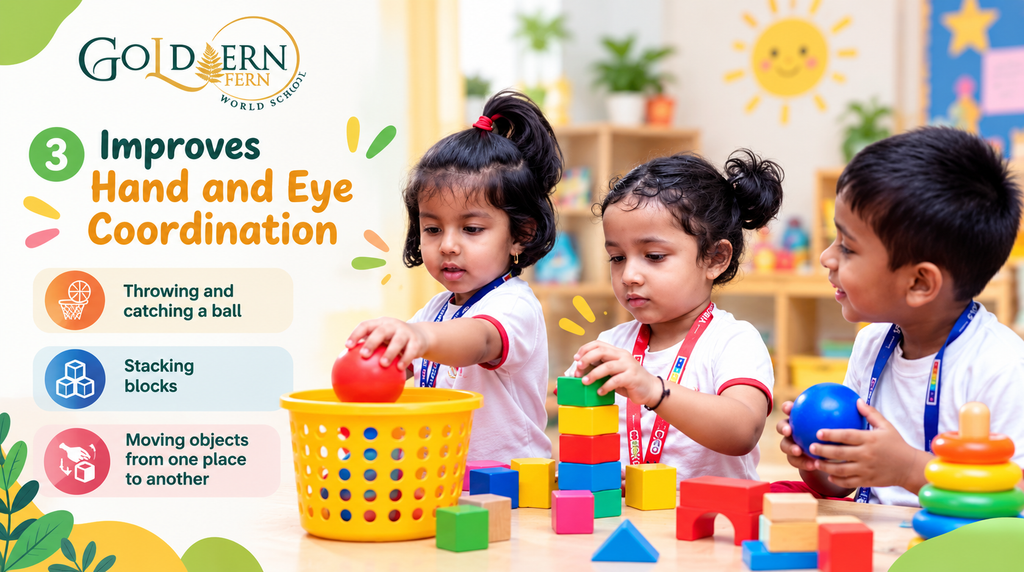
Throwing a soft ball into a basket, catching an object, stacking blocks, or moving objects from one place to another can provide useful practice.
These experiences may appear simple, but they can prepare children for everyday classroom tasks that require controlled hand movements.
4. Gives Children Opportunities to Build Confidence
A child may initially hesitate to try a new activity. With gentle encouragement, that same child may eventually complete it independently.
This small achievement can be meaningful.
When children experience success through activities such as balancing, jumping, catching, or completing a movement challenge, they can begin to feel more confident about trying something unfamiliar.
Teachers can support this process by appreciating effort instead of focusing only on performance.
5. Makes Children More Comfortable in Group Settings
Movement activities can bring children together.
A group game may require children to wait, listen, share equipment, move around others, or participate at the right time. These situations give children practical opportunities to understand how to behave around their classmates.
For example, while playing a simple ball-passing game, children can practise waiting for their turn and giving the ball to another child.
These everyday experiences can support social development.
6. Encourages Communication Between Children
Children naturally communicate when they play together.
They may ask a friend to join a game, talk about what they are doing, or respond to instructions from a teacher.
Physical activities can therefore create situations where children use language naturally rather than learning communication only through formal classroom exercises.
This can be particularly useful during group games, role play, dance, and outdoor activities.
7. Gives Children a Positive Break From Sitting
Young children do not always need to remain seated to learn.
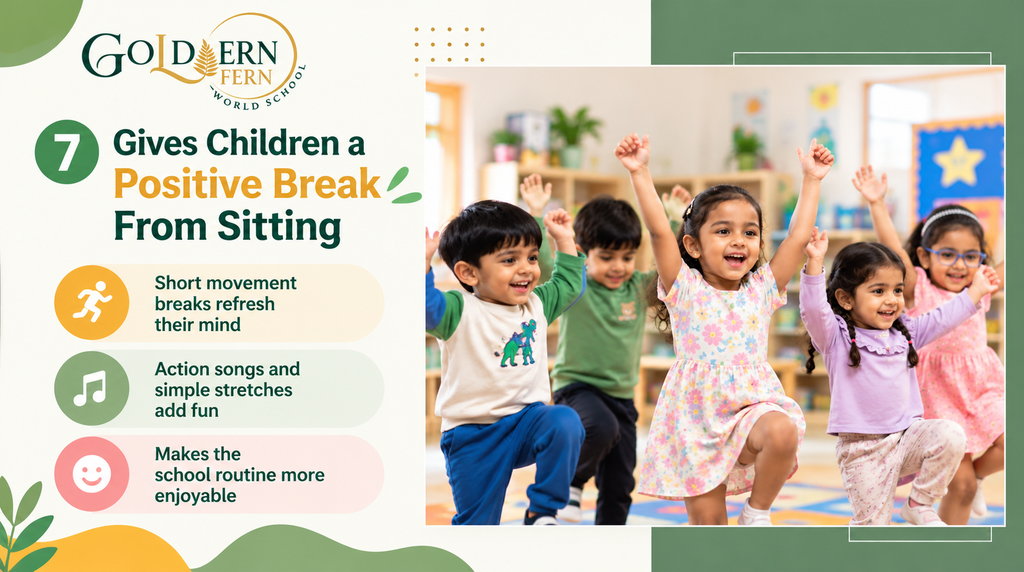
After spending time on an activity that requires attention, a short movement session can provide a welcome change.
A teacher could introduce an action song, simple stretching, or a two-minute movement game before beginning another classroom activity.
Such transitions can make the school routine more enjoyable and varied.
8. Connects Physical Movement With Classroom Learning
Movement can also be used as a teaching method.
Instead of asking children only to look at numbers on a worksheet, a teacher could ask them to jump a certain number of times.
Instead of simply showing shapes, children could use their hands or bodies to represent different shapes.
For colour recognition, children could move towards the correct coloured object.
In this way, physical activity can become part of the learning process rather than being completely separate from academics.
9. Encourages Outdoor Discovery
Outdoor spaces provide children with a different type of learning environment.
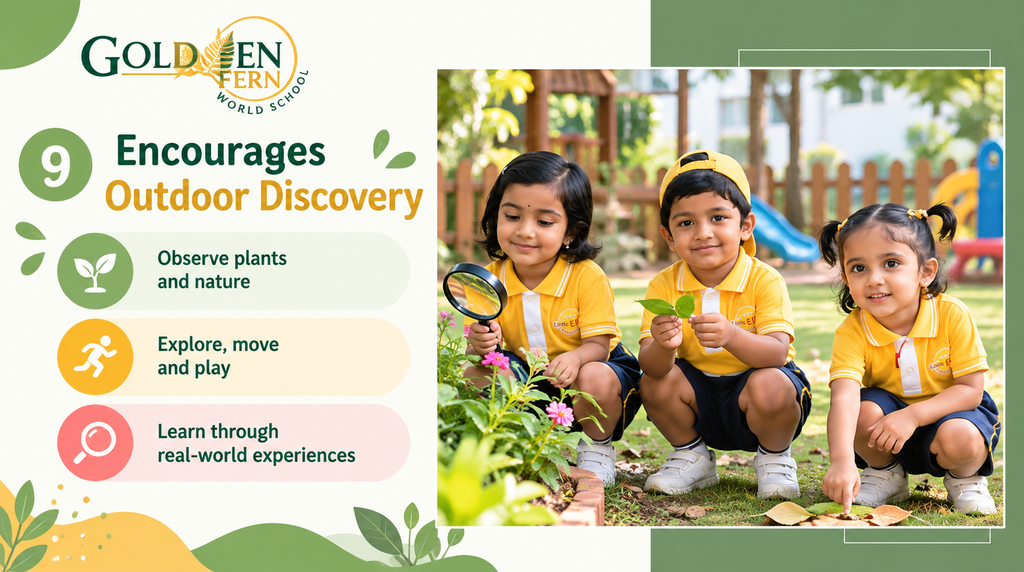
They can observe plants, notice sounds, walk across different surfaces, play simple games, and explore the space around them under supervision.
Outdoor movement can also give children opportunities to practise skills that may be difficult to experience inside a classroom.
A well-planned outdoor session can combine exploration, movement, conversation, and play.
10. Supports Independence
Many physical activities allow children to complete small tasks on their own.
A child may learn to carry a ball, arrange an object, complete a simple movement path, or choose between two activities.
These experiences encourage children to make small decisions and participate independently.
Teachers can provide guidance while still allowing children enough space to attempt activities themselves.
11. Develops Listening Through Action
Physical games can also be useful for developing listening skills.
A teacher may give simple instructions such as:
“Walk slowly.”
“Touch the circle.”
“Jump twice.”
“Stop when the music stops.”
Children need to listen carefully and respond to what they hear.
This makes listening practice more active and enjoyable.
12. Creates Opportunities for Creative Expression
Movement does not always have to follow fixed rules.
Children can also express themselves through free movement, music, dance, and imaginative play.
A teacher might play a children’s song and allow children to create their own movements. Another activity could ask children to move like different animals.
Such experiences can combine imagination with physical movement.
Simple Physical Activities for Pre-Primary Children
A pre-primary school can introduce many simple activities without making them complicated.
Some examples include:
Action Songs
Children can sing and perform actions along with familiar songs.
Ball Activities
Rolling, throwing, catching, and passing soft balls can provide enjoyable movement experiences.
Balance Games
Children can practise walking along a marked line or stepping between safe floor markers.
Mini Obstacle Paths
Teachers can create simple movement paths using safe classroom or play-area materials.
Dance and Music
Children can move freely to suitable music while following simple instructions.
Nature Walks
Supervised walks can combine physical movement with observation and conversation.
Follow-the-Leader Games
Children can copy simple movements demonstrated by the teacher or another child.
How Teachers Can Make Physical Activity Enjoyable
The way an activity is introduced can make a big difference.
Teachers can keep activities:
- Simple and age-appropriate
- Safe and well supervised
- Enjoyable rather than competitive
- Flexible for different abilities
- Short enough to maintain children’s interest
- Focused on participation and effort
Children should not feel that they have failed simply because they cannot perform a movement immediately. Every child develops at a different pace.
Encouragement and patience can make physical activity a positive part of the school experience.
Parents Can Continue Active Habits at Home
Children’s active lifestyle does not have to stop when they leave school.
Parents can encourage simple movement at home through family walks, dancing, outdoor games, ball activities, or other age-appropriate play.
The activity does not need to be complicated. Even everyday opportunities to move and play can help children develop an active routine.
A Balanced Approach to Early Learning
Pre-primary education involves much more than letters and numbers. Children are also developing movement skills, social behaviour, communication, creativity, independence, and confidence.
Physical activity can support several of these areas at the same time.
A child running with friends may be developing physical coordination, communication, turn-taking, and confidence within one simple activity.
That is what makes movement valuable in the early learning years.
Conclusion
Physical activity can make pre-primary education more active, enjoyable, and meaningful. Through running, jumping, dancing, balancing, playing, and exploring, children get opportunities to understand their bodies and interact with the world around them.
The purpose is not to make young children compete or perform difficult exercises. Instead, the focus should be on giving them safe opportunities to move, try, explore, and enjoy.
At Golden Fern World School, we believe that children deserve an early learning environment where classroom experiences, creative activities, social interaction, and physical movement come together. When children are encouraged to learn through different experiences, their school journey can become more engaging and enjoyable.