
Uncategorized
Screen Time and Young Children: Healthy Habits for Parents

Screens are now a common part of family life. Young children may see smartphones, tablets, televisions, and computers at home or in other everyday settings.
Technology can sometimes support learning and communication. However, young children also need plenty of time for active play, sleep, conversations, books, creative activities, and time with family.
This is why parents should think about creating healthy screen time habits for young children.
At Golden Fern World School, we believe that early childhood should include a balanced mix of learning, play, movement, creativity, social interaction, and rest. Helping children develop healthy routines around screens can support this balanced approach.
What Is Screen Time for Young Children?
Screen time means the time a child spends looking at or interacting with a digital screen.
This may include:
- Watching television
- Using a smartphone
- Watching videos on a tablet
- Playing digital games
- Using educational apps
- Video calling family members
- Watching online content
Not every type of screen use is the same. A short video call with a family member is different from watching entertainment videos for a long period.
Parents can therefore look at both the amount of screen time and what children are doing during that time.
Why Should Parents Pay Attention to Screen Time?
Young children learn through real-world experiences.
Playing with blocks, talking with parents, looking at picture books, drawing, singing, running, and exploring their surroundings all give children opportunities to learn.
When screen use takes up too much of the day, it can reduce time available for these activities.
WHO recommends that children under five should have plenty of physical activity and good-quality sleep, while sedentary screen time should be limited. For children aged 3–4 years, WHO recommends no more than one hour of sedentary screen time per day, with less being better. :contentReference[oaicite:1]{index=1}
The goal is not to make children afraid of screens. The goal is to create a healthy balance.
1. Set Simple Screen Time Rules
Young children understand simple rules better than complicated explanations.
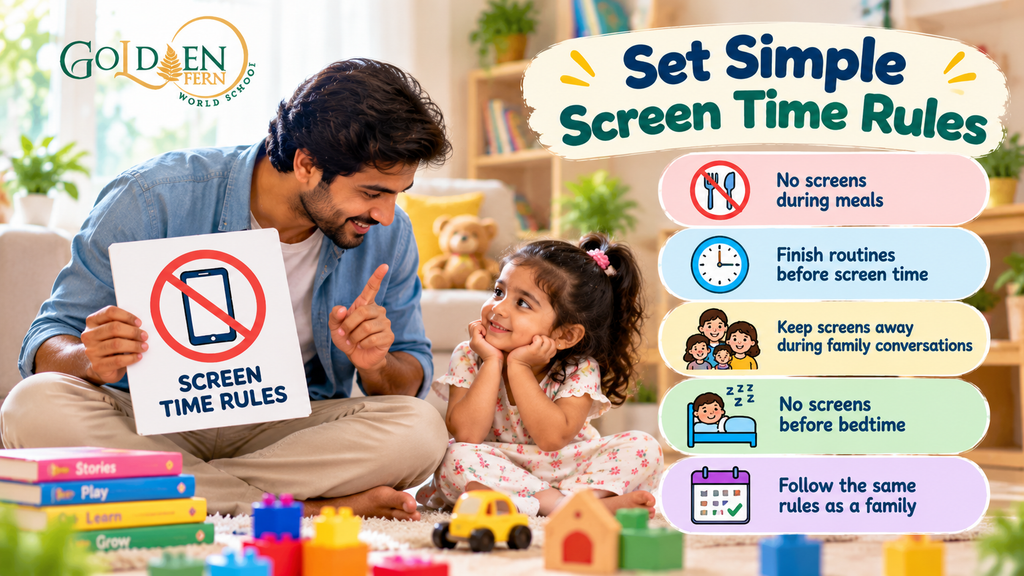
Parents can create a few clear family rules, such as:
- No screens during meals
- No screens while getting ready for school
- Keep screens away during family conversations
- Finish important routines before using a screen
- Stop screen use before bedtime
The rules should be easy for children to remember.
Parents should also try to follow the same rules whenever possible. Children often learn by watching adults.
A consistent routine can make screen limits easier to understand.
2. Choose Age-Appropriate Content
The type of content children watch matters.
Parents can choose content that is suitable for the child’s age and interests. Simple educational programmes, songs, stories, and carefully selected learning activities may be more useful than random videos.
Before giving a child a new app or video, parents can ask:
- Is this suitable for my child’s age?
- Is the content easy to understand?
- Does it encourage learning or creativity?
- Is it appropriate for my family?
- Can I watch or discuss it with my child?
Parents do not need to choose every activity perfectly. The important thing is to be involved and make thoughtful choices.
3. Watch With Your Child
Whenever possible, parents can spend some screen time with their children.
Instead of leaving a child alone with a device, sit nearby and talk about what they are seeing.
For example, while watching an educational video, a parent might ask:
“What colour is the ball?”
“What happened to the character?”
“Can you find the animal?”
“What do you think will happen next?”
These simple questions can turn passive viewing into a shared learning experience.
The American Academy of Pediatrics also encourages parents of toddlers and preschoolers to think about the child, the content, context, calming role, and communication when making media decisions. :contentReference[oaicite:2]{index=2}
4. Keep Screen-Free Mealtimes
Mealtimes can be a valuable opportunity for family interaction.
Instead of using a phone or television during meals, families can talk about their day.
Parents can ask simple questions such as:
“What was your favourite part of today?”
“Who did you play with?”
“What did you learn?”
“Which food do you like?”
These conversations help children practise listening and speaking.
A screen-free meal can also become a predictable family routine.

5. Create a Screen-Free Bedtime Routine
Young children need good-quality sleep as part of a healthy daily routine.
WHO recommends regular sleep and wake-up times for young children and emphasises the importance of balancing screen time with sleep and physical activity. :contentReference[oaicite:3]{index=3}
Parents can create a calm bedtime routine such as:
Put Away Screens → Brush Teeth → Change Clothes → Read a Story → Relax → Sleep
A picture chart can help younger children understand the sequence.
Reading a short story together can also provide a peaceful alternative to screen use before bedtime.
6. Replace Screen Time With Active Play
Simply saying “no screen” may not be enough.
Children need something interesting to do instead.
Parents can offer activities such as:
- Playing with blocks
- Drawing and colouring
- Building with simple toys
- Dancing to music
- Playing with a ball
- Looking at picture books
- Gardening with an adult
- Puzzles
- Pretend play
- Outdoor exploration
WHO recommends that young children have substantial opportunities for physical activity throughout the day. For children aged 3–4 years, the guideline recommends at least 180 minutes of physical activity spread across the day. :contentReference[oaicite:4]{index=4}
The activity does not have to be complicated. Simple play can be enough.
7. Encourage Creative Activities
Creative activities give children opportunities to use their imagination.
Parents can provide simple materials such as:
- Crayons
- Paper
- Clay
- Colouring books
- Building blocks
- Puzzles
- Picture cards
- Storybooks
Children can draw a family picture, build a house with blocks, create shapes with clay, or make up a simple story.
These activities give children opportunities to explore ideas without depending on a screen.
8. Teach Children to Take Breaks
Young children may become deeply interested in a video or game.
Parents can give children a simple warning before screen time ends.
For example:
“Five more minutes, then we will put the tablet away.”
After the screen is turned off, offer another activity.
A child might move from watching a short video to:
Screen Off → Drink Water → Move Around → Play → Read
This makes the transition easier than suddenly stopping without explanation.
9. Avoid Using Screens for Every Difficult Moment
Sometimes parents use screens to calm a child, keep them busy, or make a difficult situation easier.
This can be understandable during a busy day.
However, children also need opportunities to learn other ways to manage boredom, waiting, frustration, and strong emotions.
Parents can gradually introduce alternatives such as:
- Deep breathing together
- Looking at a picture book
- Playing quietly
- Listening to music
- Talking about feelings
- Drawing
- Helping with a simple task
The aim is not to remove every difficult moment. It is to help children gradually develop different ways to cope.
10. Be a Good Screen-Time Role Model
Children notice what adults do.
If parents are constantly checking phones during meals, conversations, or playtime, children may naturally become interested in doing the same.
Parents can show healthy habits by:
- Putting phones away during conversations
- Keeping devices away during meals
- Choosing family activities
- Taking regular breaks from screens
- Spending time outdoors
- Reading books
- Giving children their full attention during important moments
A healthy digital routine becomes easier for children when adults practise it too.
How Can Parents Create a Simple Screen-Time Routine?
A simple daily plan can make screen use easier to manage.
For example:
Morning:
Get ready → Breakfast → School
After School:
Snack → Rest → Outdoor or Active Play
Later:
Creative Activity → Limited Screen Time
Evening:
Dinner → Family Time → Story → Bedtime
The exact routine will be different for every family.
The important part is to make sure screen use does not replace sleep, active play, family interaction, reading, and other important childhood experiences.
What Should Parents Remember?
ents do not need to create a completely screen-free childhood.
Instead, they can focus on balance.
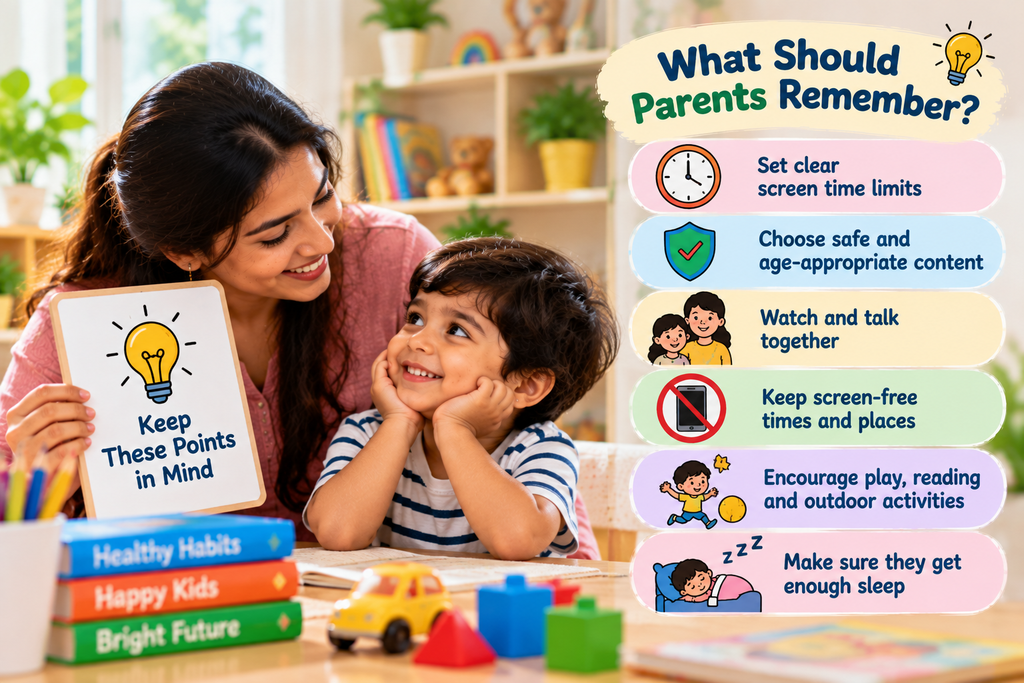
A healthy routine can include:
- Active play
- Outdoor time
- Family conversations
- Reading
- Creative activities
- Healthy meals
- Enough sleep
- Limited and purposeful screen use
For children under five, WHO guidance places particular emphasis on replacing sedentary screen time with active play and interactive activities such as reading and storytelling with caregivers. :contentReference[oaicite:5]{index=5}
Every family is different. Parents can choose routines that suit their child’s age, needs, family schedule, and environment.
Final Thoughts
Healthy screen habits begin with simple choices.
Parents can set clear limits, choose suitable content, watch with their children, create screen-free routines, and offer plenty of opportunities for play and conversation.
The aim is not to make technology the enemy. It is to make sure screens have a balanced place in a child’s day.
At Golden Fern World School, we believe young children learn best through a rich combination of play, interaction, movement, creativity, stories, and meaningful experiences.
With patient guidance and consistent routines, parents can help children build healthy habits that support their learning and development both at home and at school.